Please note: Applications are now closed!
About the National Medical Director Scheme
Sponsored by the National Medical Director of NHS England and managed by FMLM, the scheme is designed to identify and support doctors in training who present with the clearest potential to develop as clinical leaders of the future. Established in 2011, the scheme provides doctors in training with a unique opportunity to spend 12 months in healthcare-affiliated organisations outside of clinical practice to develop their skills in leadership, management, strategy, project management and health policy.
This scheme is for doctors in training from all specialties who have completed both years of foundation training by the start of the fellowship, commencing in September, each year. Candidates are eligible to apply providing they have full General Medical Council registration and will not gain CCT before 1 September of the year they are applying (General Practice ST3 trainees with CCT before or around 1 September of the year they are applying are eligible to apply but will need to defer CCT). Applications are also welcome from public health specialty trainees who meet the eligibility criteria.
Clinical fellows have the opportunity to work with senior leaders to develop their leadership skills and experience in a diverse range of organisations. The participating organisations have the opportunity to be part of a prestigious scheme to develop a growing community of future clinical leaders who will go on to shape healthcare in this country.
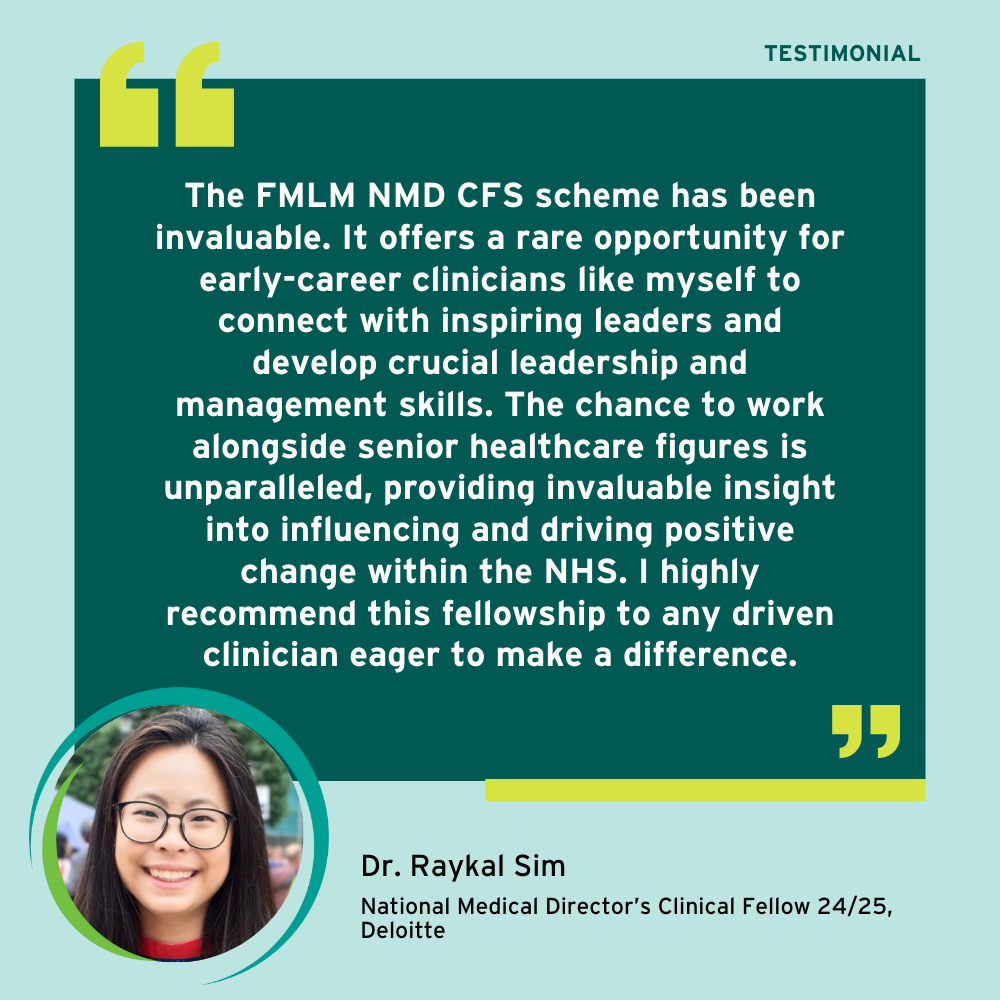
What are the benefits of becoming a Clinical Fellow?
Successful candidates gain:
- A range of skills including leadership and management, policy development, project management, research and analysis.
- Supported leadership and personal development.
- The opportunity to lead key national projects which contribute to national healthcare priorities.
- Access to professional networks across healthcare at all levels.
- A highly developed understanding of healthcare policy and application.
- The skills to lead positive change.
- Enhanced capabilities at developing and working with teams and supporting others in developing their own personal insight and effectiveness.
What are the learning aims of the role?
Practice-oriented, evidence-based, theory-informed
To develop clinical fellows’ leadership and management knowledge and skills through experiential learning, supported by relevant evidence, concepts and theories, so that they can ‘make a difference’ to healthcare delivery and advance their individual capability
- To achieve a deeper insight into personal behaviours, leadership style and impact on others.
- To enhance emotional and social intelligence.
- To nurture and encourage personal agency.
- To enhance effectiveness as reflective practitioners.
Interprofessional and UK-wide
- To achieve a greater understanding of the wider context in which leaders operate across the healthcare system.
- To bring clinical fellows from different schemes and professions together to work and learn from one another.
- To support clinical fellows to work more effectively with colleagues in delivering and improving services for patients.
Co-creative and collaborative
- To provide opportunities for co-creation and collaboration on system, service, quality improvement and professional development.
- To support clinical fellows’ wellbeing and resilience.
- To gain insights into the challenges of and ways to lead through complexity.
- To develop a greater understanding of team-working and system leadership.