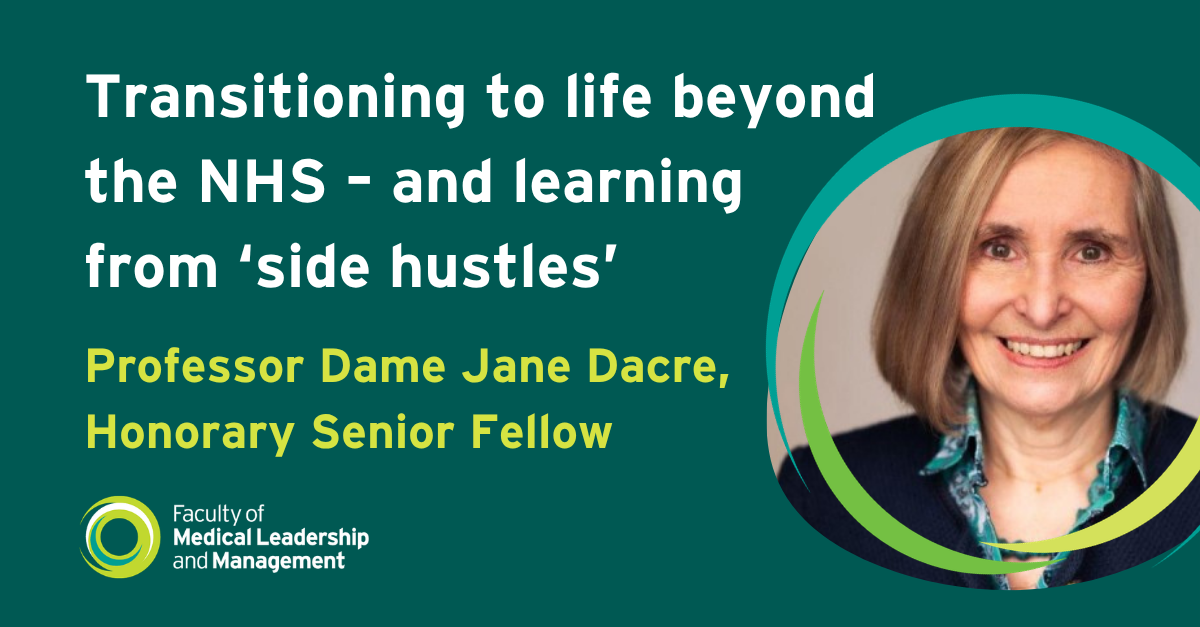
Professor Dame Jane Dacre, Honorary Senior Fellow at FMLM, reflects on transitioning beyond the NHS and the value of building a portfolio career. Drawing on her own experience across clinical medicine, education and leadership, she explores how ‘side hustles’ can support wellbeing, strengthen networks and shape more sustainable careers.
Working in a healthcare system like the NHS is often all encompassing and encroaches on life beyond what they call the day job. This can make it difficult to stop, without losing our sense of personal value, or professional identity. In parallel, there are big benefits to taking a step back and looking at the system, and one’s own life from a distance.
The development of a portfolio career, either alongside the NHS job, or as a career alternative is gaining traction amongst medical professionals as an effective, and sometimes more sustainable way of working and reducing burn out.
Throughout my career in medicine, I have always found it helpful to have what are called ‘side hustles’, a job, or paid activity done in addition to the main job. I have found it a welcome relief from the relentless pressure of clinical medicine. It provides an opportunity for interaction with like-minded colleagues from a different work setting. The issues are often similar, but a shared approach from a different perspective is helpful. It also builds a network of colleagues to go to for advice and guidance, and for a fresh perspective. The relationships that are built are often what I call longitudinal relationships. These are not colleagues you see every day, or even every week, but over a period of a few years, they become close allies and professional friends; people you can rely on for good honest advice.
In medicine, there are a large number of organisations which provide this opportunity. The Medical Royal Colleges, the GMC, and the BMA are examples of this. The range of views, the different organisational cultures, and the colleagues from different specialties all enrich the overall career experience. We can learn how to do things differently, and that some complex problems are not so complex if looked at in a different way. This is a powerful way of developing experiential learning in medical leadership, building networks, and making challenges more manageable.
One of my most impactful additional roles, or side hustles has been in the Royal College of Physicians, where I began working in the MRCP exams office due to my background in medical school exams at UCL, and worked through the RCP ranks, eventually being elected President in 2014. I was the 100th President, but only the third woman to have had the role. It was not an easy job, and there were plenty of challenges which needed to be addressed. We didn’t always get it right, but we worked together to do our best as a team of committed individuals with complementary skills. I am still involved in other healthcare organisations that have introduced me to new colleagues with a range of new ideas and perspectives. I have been privileged to have been recognised by many of these external organisations along the way, including the FMLM, and to have continued in my role at UCL until recently.
Throughout my career, working across medical education and clinical medicine has honed my skills. My training and skills as an educator were invaluable in chairing a large board, like the RCP Council; making a clear differential diagnosis and management plan in a tricky clinical case has helped me to develop problem solving skills; my dealing with complex communication challenges with patients has helped me to develop negotiation skills. The skills learnt in ‘side hustle’ jobs are all generic and generalisable. The relationships I have made in the external organisations become a wide and powerful network, and an enabler of soft power.
So then, when the time comes to transition to life outside the NHS, or even alongside the NHS, you can take those skills with you. At first it feels as if everyone knows more than you do…..the imposter syndrome, but if you persevere, you realise that you still have something to offer, and are respected for it.
Having a set of additional attributes, acquired from other organisations, and an open approach makes a good leader. If that is added to an understanding of yourself, how you respond in team settings and under difficult circumstances, that makes you a better leader. The addition of some leadership theories, and the opportunities to practice on some leadership tasks, helps you to understand the rationale behind your approach, and improves your leadership ability even more.
I am now retired from the NHS, and have an emeritus position at my university (UCL). Although, initially, it felt daunting, as if I was on my own, I soon learnt the benefits of becoming an independent leader, with my own opinions. My learning from my ‘side hustles’, in addition to the experience gained from many years in the day job have facilitated a transition to a portfolio career.
I no longer feel obliged to get involved in the parts of my old jobs that I regarded as a chore. I no longer feel guilty if I am not in a hospital or in an office every day.
I haven’t strayed too far, and my current roles are all related to healthcare and education. Some are paid, and some are not. I am President of the Medical Women’s Federation and the Royal Medical Benevolent Fund, both charities that support doctors in some way. I am also President of the Medical Protection Society, an indemnity organisation which supports doctors and dentists in a different way. I still have roles in the Department of Health and Social Care, and the Government, and I have a role in inspecting overseas medical schools. All of these are on a part time basis, and enrich my career experience.
I now have time to have a better work life balance, to follow my passions, and to spend more time with my grand-children (although the timetabling is sometimes tricky).
This transition has been easier for me because throughout my career, I have always had medically related additional or outside interests. This has kept me going during the difficult times, has protected me from burnout, and strengthened my position as an independent leader. I still contribute to the NHS…… on my own terms.
Professor Dame Jane Dacre
Honorary Senior Fellow at FMLM