

Professor Mark Taubert, Senior Fellow at FMLM, reflects on a day spent at the European Parliament promoting the Future Care Planning (FCP) work undertaken in NHS Wales.
When I asked Nicole, one of my clinic patients, if she’d speak to MEPs in Brussels about planning her future care, she asked when she should pack. At the European Parliament, she told them how often she’d had to start the very conversations she wished her clinicians would open. Her experience points to a challenge for clinical leaders: how do we help people talk about what matters to them before a crisis, and make sure those wishes are visible when decisions have to be made? In this FMLM blog, I share what Wales is doing to make that possible and what we can learn from colleagues across Europe.
The importance of planning future care
I am chair of the All Wales Future Care Planning strategy board hosted by NHS Wales Performance and Improvement, but am also Vice President and member of the board directors of an NGO called the European Association for Palliative Care (EAPC).
Talking about the future, particularly when progressive illness is involved, can be a challenge. But some of my patients, once they have the full picture and a lot more information about their condition(s), will wish to put their views, wishes and preferences in place and make them accessible to health and social care providers.
Quite a sizeable number of my patients have specific care plans and these been uploaded to the Welsh Clinical Portal Future Care Plan flag, for documents like Advance Decisions, and also in the Patient Preferences section for softer preferences, e.g. "This is what I want to happen with Chico my dog, if I am unwell at home, and less able to communicate and engage due to my illness".
Taking Wales' approach to future care planning to Europe
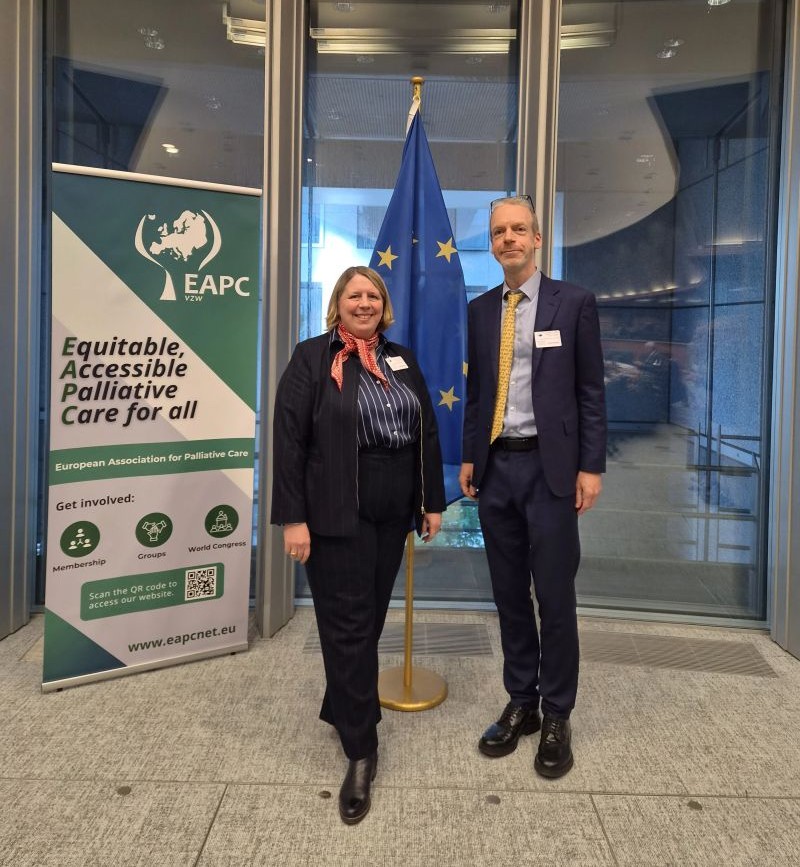
Nicole and I travelled to Brussels with presentations and speeches at the ready, after having been invited there by the organising MEP Aurelius Veryga. The EAPC was hosting the event and once we had passed security and received our European Parliament security badges, we joined the Altiero Spinelli meeting room. Rooms are equipped with interpreting and sound booths and equipment, and we were an international crowd, including representation from Greece, Spain, Ireland, Lithuania, Belgium and the Netherlands, to name a few. Whilst the work we presented on Future Care Planning was conceived in a current non-EU member state, a lot of the workstreams are of huge interest internationally, and in fact were started when the UK was still a member prior to 2016.
Our session was entitled: 'Supporting patients through the Future Care Planning journey' - Accessible palliative care: wherever you live and whenever you need it.
The workstreams we presented to EU colleagues have been adopted by Welsh Government and are aligned with the 'A healthier Wales long term plan for health and social care'. It has also been operationalised into the Welsh government’s 'Six goals for urgent and emergency care', and supported by a national all-Wales DNACPR policy and a central hub of resources and training. This is of interest across Europe where challenges in the acute and emergency health sector are similar to those experienced in the UK. One MEP described this area as difficult to broch and easier to avoid, especially if it brings up the sensitive topic of care and living towards the end of life.
Making future care planning part of everyday practice
Palliative care and FCP are relevant at every stage of life and can include people with diminished or fluctuating capacity, supported for example through the record of agreed best interests (RBID) form and policy. In the networking events between talks, I was able to speak to an Irish MEP who noted in his remarks that this is a huge area of interest for him and the area of Dublin he represents.
One of Wales’ most accessed education tools is the TalkCPR treatment ladder approach, which guides clinicians and patients through potential interventions, from least to most invasive. A conversation might start with intravenous antibiotics or fluids and gradually work towards more intensive interventions, including cardiopulmonary resuscitation and it’s high intensity but limited success in people with very advanced illness.
Why conversations matter: the patient's perspective
Nicole spoke about the awkwardness of some professionals in bringing these topics up. As an informed patient, she managed most of the referrals into support services herself, and noted an awkwardness amongst non-palliative healthcare professionals to talk about care when she is less well and perhaps less able to communicate. This was particular important to her as someone with no direct family locally where she lives.
Clinicians are encouraged to be open about likely benefits, burdens and outcomes, an approach that brings clarity, realism and reassurance. Patients and carers have been closely involved, including allowing camera access to a real DNACPR consultation with a woman in her thirties.
To make FCP genuinely shared, Wales has developed an electronic patient record flag for FCP discussions and forms, and all health boards and trusts are now, since 2026, able to add the FCP flag to their electronic Welsh Clinical Portal (WCP) entries. This will include the option of uploading specific forms, including patient-held copies of their last power of attorney for health and welfare, or advance decision to refuse treatment (ADRT). Nicole has completed this and many others have, too. Work is also ongoing to integrate this Welsh Clinical Portal FCP flag for read and write updatability within primary care, via the All Wales WCP Instance and patients can take control of these records by adding them to a QR code wristband, another project that is being piloted in Wales.
Good access to palliative care and FCP can help offer clarity at moments of uncertainty, reduce unwanted interventions and help clinicians deliver care aligned with patients’ values. The EU parliament meeting heard presentations from members including the Spanish carer representative Carmen Vanesa Diaz Hernandez, outlining how information and communication can be improved for those close to the patient. Nicole and I joined a panel discussion to talk about elements of what had been said, and MEP Aureliys Veryga, who kindly hosted the day's proceedings, summarised the need for better and more structured palliative care across Europe, with a need for politicians to engage with this topic honestly and without fear.
Looking ahead: a shared commitment across Europe
The day was unlike anything I have experienced in my career, despite having given evidence in political forums such as the Welsh Senedd, and the UK House of Lords in the past. Conversations and commitments supported meaningful, honest and individualised actions for those who attended, and the patient and care presentations were listened to intently.
After all, patient care in progressive illness should be individualised to each person and those close to them. I believe that in Wales we are building a system to make that possible, and we must do so not alone, but in the wider UK and European systems that after all face all the same challenges.